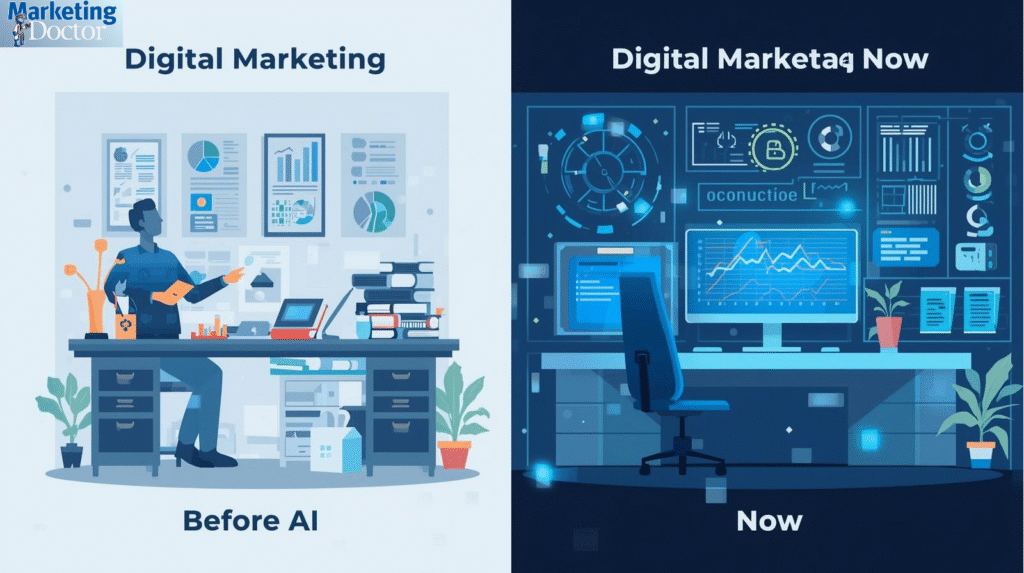
Digital Marketing Before AI vs Digital Marketing Now: What Has Really Changed?
Digital marketing has gone through a massive transformation over the last decade. What once depended heavily on manual work, guesswork, and long timelines has now become faster, smarter, and more data-driven—thanks largely to Artificial Intelligence (AI). For professionals like doctors, clinics, and hospitals, this shift has completely changed how patients discover, evaluate, and choose healthcare services online, making digital marketing for doctors more strategic and results-oriented than ever before. Understanding the difference between digital marketing before AI and digital marketing now is essential for staying competitive in today’s healthcare market.
Let’s explore how things used to work, how AI has reshaped digital marketing, and what this evolution means for modern medical practices.
Digital Marketing Before AI: The Traditional Era
Before AI became a part of digital marketing, most strategies relied on manual execution and limited data insights. Results were slower, less accurate, and often required a lot of trial and error.
1. Manual Market Research and Guesswork
Earlier, digital marketers depended on basic tools and assumptions. Keyword research was limited, audience behavior was difficult to track, and understanding patient intent was mostly guesswork.
For healthcare businesses, this made digital marketing for doctors less predictable. Campaigns were created based on general trends rather than specific patient needs.
2. Basic SEO Practices
SEO before AI focused mainly on:
- Keyword stuffing
- Simple backlink building
- Meta tags and basic on-page optimization
Search engines were less intelligent, so ranking often depended on how many times a keyword appeared rather than content quality. Medical websites could rank, but patient trust and engagement were often low.
3. Generic Content Creation
Content was usually written for search engines, not for users. Blogs were repetitive, long, and lacked real value. There was little focus on answering patient questions or explaining treatments in a simple way.
This limited the effectiveness of digital marketing for doctors, as patients could not easily connect with the content.
4. Manual Social Media Management
Social media posting was done manually without proper analytics. There was no clear understanding of:
- Best posting times
- Content performance
- Audience engagement patterns
Healthcare brands often posted randomly, hoping something would work.
5. Limited Advertising Optimization
Paid ads on Google or Facebook were basic. Marketers set budgets, selected keywords, and waited. Optimization took weeks, and ad performance depended heavily on experience rather than real-time data.
For clinics, this meant higher costs and lower returns.
The Rise of AI in Digital Marketing
AI introduced automation, intelligence, and deep data analysis into digital marketing. Instead of guessing, marketers could now rely on real insights and predictive behavior.
This shift changed everything—especially in competitive fields like healthcare.
Digital Marketing Now: The AI-Driven Era
Today, digital marketing is faster, smarter, and far more patient-focused. AI tools help businesses understand exactly what users want and how to deliver it effectively.
1. Smart Audience Targeting
AI analyzes:
- Search behavior
- Online activity
- Location data
- Past interactions
This allows highly precise targeting. In digital marketing for doctors, AI helps target patients based on symptoms searched, local intent, and treatment needs—leading to better-quality leads.
2. Advanced SEO with Search Intent
Modern SEO is no longer about stuffing keywords. AI-powered search engines like Google now focus on:
- User intent
- Content relevance
- Experience and trust (E-E-A-T)
AI tools help identify what patients are actually searching for and suggest content topics that answer real medical questions clearly and ethically.
3. High-Quality, Personalized Content
AI helps marketers create content that is:
- Informative
- Patient-friendly
- Structured for readability
Content now focuses on education rather than promotion. This has significantly improved digital marketing for doctors, as patients trust doctors who explain conditions, treatments, and procedures transparently.
4. AI-Powered Chatbots and Instant Support
Earlier, patients had to call clinics or wait for email replies. Now, AI chatbots:
- Answer basic queries instantly
- Book appointments
- Share clinic information
This improves patient experience and increases conversion rates, especially for busy medical practices.
5. Real-Time Advertising Optimization
AI continuously monitors ad performance and automatically:
- Adjusts budgets
- Changes bidding strategies
- Tests multiple ad copies
This ensures better ROI. Clinics using AI-driven ads see more appointment bookings at lower costs, making digital marketing for doctors more efficient than ever before.
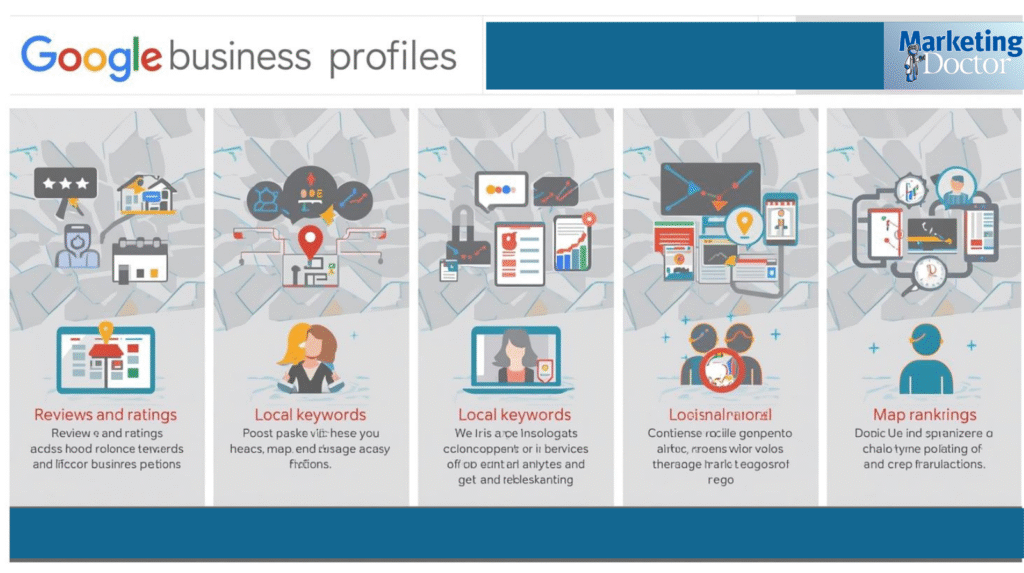
6. Local SEO Enhanced by AI
Local search is critical for doctors. AI helps optimize:
- Google Business Profiles
- Reviews and ratings
- Local keywords
- Map rankings
AI tools analyze competitor performance and suggest improvements to boost visibility in local searches like “best dentist near me” or “orthopedic doctor in [city].”
7. Data-Driven Decision Making
Earlier, decisions were based on assumptions. Now, AI provides clear insights through dashboards showing:
- Patient journey
- Conversion paths
- Content performance
Doctors and clinics can clearly see what’s working and what’s not.
Key Differences: Before AI vs Now
| Aspect | Before AI | Now with AI |
| Research | Manual & limited | Data-driven & predictive |
| SEO | Keyword-focused | Intent & quality-focused |
| Content | Generic | Personalized & educational |
| Ads | Slow optimization | Real-time optimization |
| Patient Experience | Delayed responses | Instant & interactive |
| Results | Uncertain | Measurable & scalable |
Why This Shift Matters for Doctors
Healthcare is built on trust. Patients today expect accurate information, quick responses, and a professional online presence.
AI-driven digital marketing for doctors helps:
- Build credibility
- Educate patients
- Improve visibility
- Increase appointment bookings
Doctors who still rely on old marketing methods often struggle to compete with clinics that use AI-powered strategies.
Challenges of AI in Digital Marketing
While AI offers many benefits, it also comes with responsibilities:
- Medical content must remain ethical and accurate
- Patient data privacy must be protected
- Human expertise is still essential
AI should support doctors—not replace professional judgment or personal connection.
The Future of Digital Marketing in Healthcare
The future will see even deeper AI integration, including:
- Voice search optimization
- Predictive patient behavior analysis
- Personalized healthcare journeys
Clinics that adapt early will stay ahead, while others may struggle to maintain visibility.
Conclusion
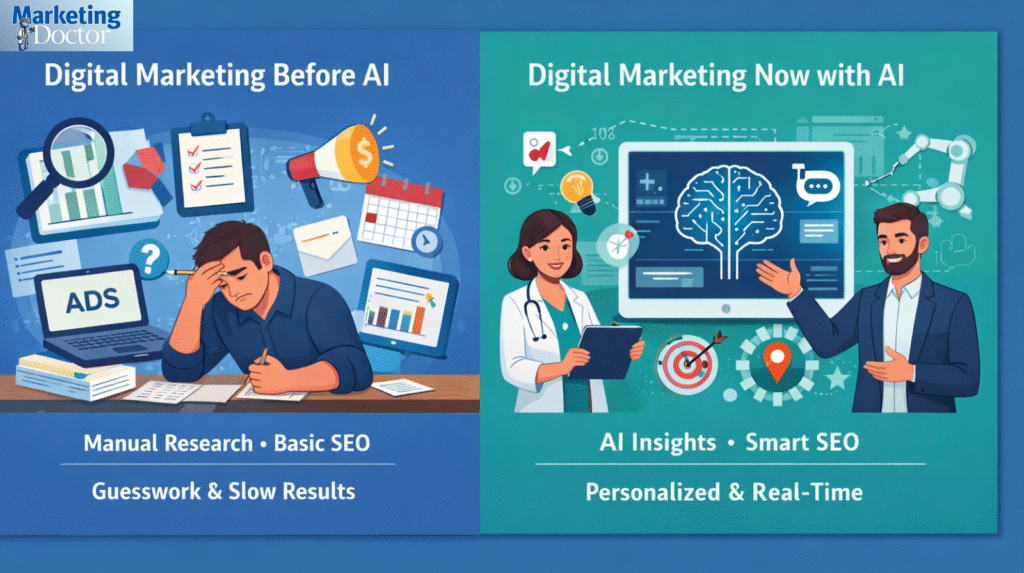
Digital marketing before AI was slow, manual, and uncertain. Digital marketing now is intelligent, fast, and patient-centric. For healthcare professionals, this change is not optional—it’s essential.
By embracing modern strategies, digital marketing for doctors becomes more effective, affordable, and trustworthy. The key is combining AI technology with medical expertise to create meaningful patient experiences.
Those who understand and adapt to this shift will lead the future of healthcare marketing.